
The Earth Sciences course at Oxford will certainly keep you on your toes! Expect a mixture of lectures, classes, tutorials and practicals staring down microscopes as standard, but the variation is what keeps the course exciting, much like the exciting and varied Earth we live on!
What is 'Earth Sciences'?
|
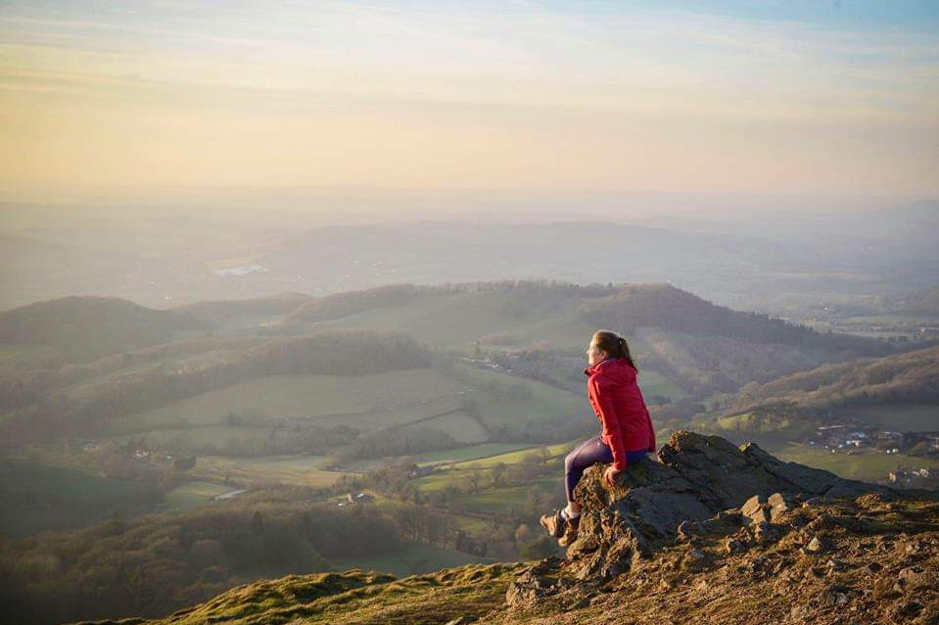
Becca currently studies as a 3rd year undergraduate student at Univ College.
|
About the Course
Earth Sciences is quite a niche subject that you don’t find at many other universities. Often, it’s labelled as Geology, but at Oxford the subject takes a broader title that encompasses practically all the natural science subjects alongside geology and a whole lot of maths. Normally, this short-form description is the one I would use to explain it. But this does not do the subject justice.
Under the umbrella term of natural sciences, you find physics, chemistry and biology, as well as maths. Most people will not, however, have encountered the geology component of Earth Sciences before. Geology involves studying the solid Earth: its origin, composition and structure. In a way, it’s a one-up on physical geography – it does include some of the more geography-like topics like climate and volcanoes but taught with scientific rigour through time and space. Below are some example disciplines within geology (there are many):
If there’s one discipline in Earth Sciences that links them all together, it’s maths. I severely underestimated the extent to which maths would be involved in this degree course, despite it being a compulsory subject to apply with at A-Level. Within the first term of first year, the maths lecture course has you tackling second order differential equations, moments of inertia and partial derivatives. But fear not! If you’re committed to working hard and putting in the practice on problem sets, you’ll cope just fine! The same goes for the science subjects covered by the course. The first year is designed to ‘level the playing field’ and put everyone on the same page, since people come in with slightly different A-Levels.
Earth Sciences is quite a niche subject that you don’t find at many other universities. Often, it’s labelled as Geology, but at Oxford the subject takes a broader title that encompasses practically all the natural science subjects alongside geology and a whole lot of maths. Normally, this short-form description is the one I would use to explain it. But this does not do the subject justice.
Under the umbrella term of natural sciences, you find physics, chemistry and biology, as well as maths. Most people will not, however, have encountered the geology component of Earth Sciences before. Geology involves studying the solid Earth: its origin, composition and structure. In a way, it’s a one-up on physical geography – it does include some of the more geography-like topics like climate and volcanoes but taught with scientific rigour through time and space. Below are some example disciplines within geology (there are many):
- Mineralogy – the study of minerals.
- Palaeontology/Palaeobiology – the study of fossils and their ecologies.
- Stratigraphy – the study of how rock strata are layered and ordered.
- Geodesy – the mathematical study of the shape and form of the Earth.
- Isotope geology – using major and trace element isotopes to track the evolution of the Earth and Solar System through time.
- Field work – can have many aims, but all use measurement-making as a basis for quantitatively drawing up an understanding of a landscape’s geological history. (Field trips are also really good for making friends with people on the course, and can be quite fun too!)
If there’s one discipline in Earth Sciences that links them all together, it’s maths. I severely underestimated the extent to which maths would be involved in this degree course, despite it being a compulsory subject to apply with at A-Level. Within the first term of first year, the maths lecture course has you tackling second order differential equations, moments of inertia and partial derivatives. But fear not! If you’re committed to working hard and putting in the practice on problem sets, you’ll cope just fine! The same goes for the science subjects covered by the course. The first year is designed to ‘level the playing field’ and put everyone on the same page, since people come in with slightly different A-Levels.
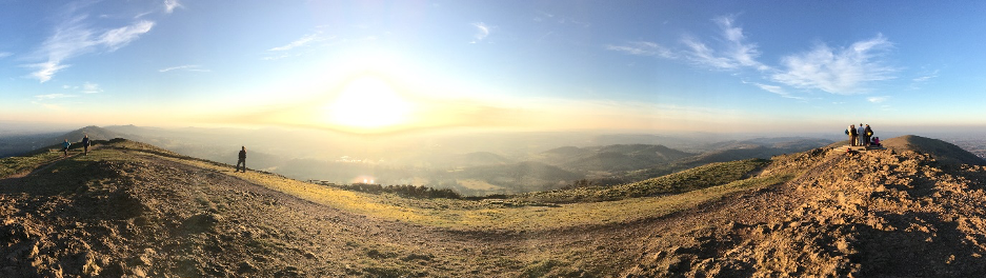
For one of our tutorials in 2nd year we were lucky enough to be taken on a day field trip to the Malvern Hills (pictured here) which is located in the West Midlands, England.
Course Structure
Typically, in your first and second year you have ~16-20 hours of lectures, problem classes and practicals per week. The timetables can be quite variable week on week, so this is very much an average. For example, below are two completely different weeks’ timetables from the past year. In the first, I only had 9 hours of lectures and classes, but in the second example I had a much heftier 22 hours. The variation can make some weeks seem more intense than others, though not unmanageably so. You will get given your full term’s timetable at the very start of term, meaning you'll be able to see when the busier weeks are going to be so you can plan around them. However, even in the quieter weeks you will still have tutorial work and problem sheets to busy yourself with.
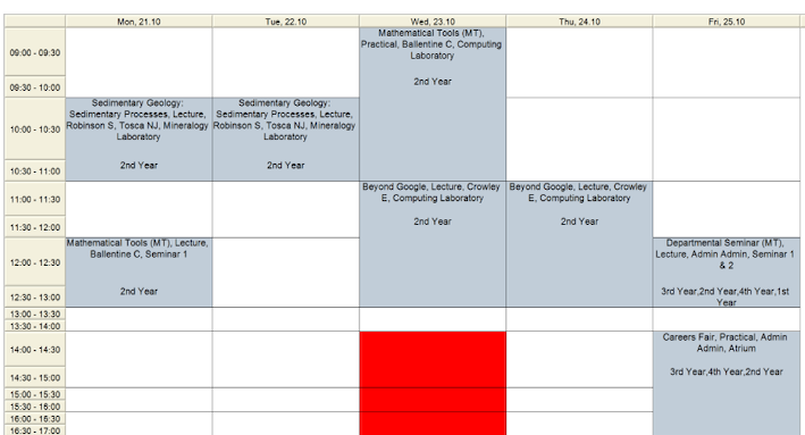
An example of a typical week’s worth of lectures for a 2nd Year student . This particular example shows the timetable for the 2nd Week of Michaelmas Term (i.e. the Autumn term) in 2019.
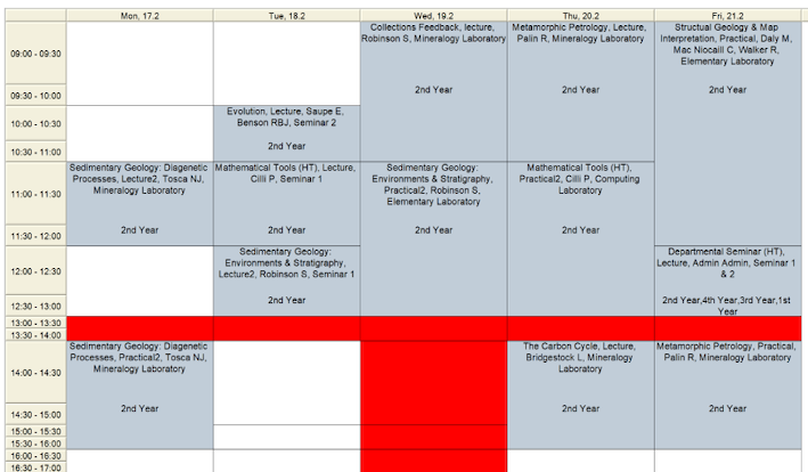
Another example timetable, this time showing a much busier week of lectures. This particular example shows the 2nd year timetable for the 7th Week of Hilary Term (i.e. the Winter-Spring term) in 2020.
NB: Your timetables are Department-arranged, which means they won’t include your tutorials on them. Tutorials are arranged separately by your College tutor, and you will typically do them along with the other Earth Scientists at your College, especially for the first two years of the course, and normally in groups of ~2 - 5 students per tutorial (depending on which College you end up at). Students may also arrange their own additional tutorials (normally via your College tutor, but sometimes through directly asking a particular lecturer or PhD student) in order to cover any topics or material that you don't feel as comfortable with and would like to go over. Also, unlike most other subjects, your tutorials will more often than not take place within the Department itself, which is really handy if your tutorials are between lectures!
In your third year you usually have far fewer lectures and practicals (typically only ~10 contact hours per week) so that you have more time for self-study and to work on your coursework: an extended essay on a geoscience topic of your choice, and a written report summarising the mapping project you will undertake the Summer after your second year. In third year you will also get the opportunity to choose from a range of different modules so that you can study in greater depth the subjects you're most interested in. As you specialise you will typically organise more of your own tutorials (together with the other Earth Scientists taking the same module(s) as you) in order to explore the topics you've chosen even further! In fourth year your lectures are replaced with discussion-based seminars, and you will usually have even fewer contact hours (~4-6 hours per week) to allow you to spend the majority of your time working with your chosen supervisor(s) on your 4th year project. For more specific information about which modules are available for you to take each year, have a look at the Earth Sciences Department’s Course Information page.
In your third year you usually have far fewer lectures and practicals (typically only ~10 contact hours per week) so that you have more time for self-study and to work on your coursework: an extended essay on a geoscience topic of your choice, and a written report summarising the mapping project you will undertake the Summer after your second year. In third year you will also get the opportunity to choose from a range of different modules so that you can study in greater depth the subjects you're most interested in. As you specialise you will typically organise more of your own tutorials (together with the other Earth Scientists taking the same module(s) as you) in order to explore the topics you've chosen even further! In fourth year your lectures are replaced with discussion-based seminars, and you will usually have even fewer contact hours (~4-6 hours per week) to allow you to spend the majority of your time working with your chosen supervisor(s) on your 4th year project. For more specific information about which modules are available for you to take each year, have a look at the Earth Sciences Department’s Course Information page.
|
Your Daily Hub: The Earth Sciences Department
The Earth Sciences Department is new and state-of-the-art, making for an impressive working environment. With such busy days in your schedule, the Department becomes a place where you spend a lot of your time. Facilities for undergraduates include the seminar rooms, laboratories or ‘labs’, an open working space in the ‘Atrium’ and the library. We are really lucky to have our own departmental library as it means there is less competition for textbooks within College libraries, and it is accessible 24 hours a day. The labs include a Computing Lab, where you have programming and geological software classes; the Mineralogy Lab, where you use the petrographic microscopes to look at cut-throughs of rocks called thin sections (see photos), enabling you to infer the minerals and textures that make up a rock, and the Elementary Lab, where you do exercises like analysing fossils, drawing geological maps and interpreting seismograms or seismic sections. The rest of the Department is mostly comprised of research labs (which you sometimes use for tutorials, though this depends on the tutor), meeting rooms, as well as offices belonging to the Department faculty and postgraduate students. On the top floor of the Department building is the Researcher Common Room or the 'RCR': a cosy couch-filled common room and balcony area which provides stunning views across the city. This area is predominantly used by faculty and postgraduate students as a space to grab a cup of coffee, to share and exchange ideas throughout the day, as well as to enjoy Friday night 'Happy Hour' drinks. As an undergraduate student you will also be able to utilise the RCR in the 4th year of your degree! On occasion OUGS are also able to use this space to host certain events. 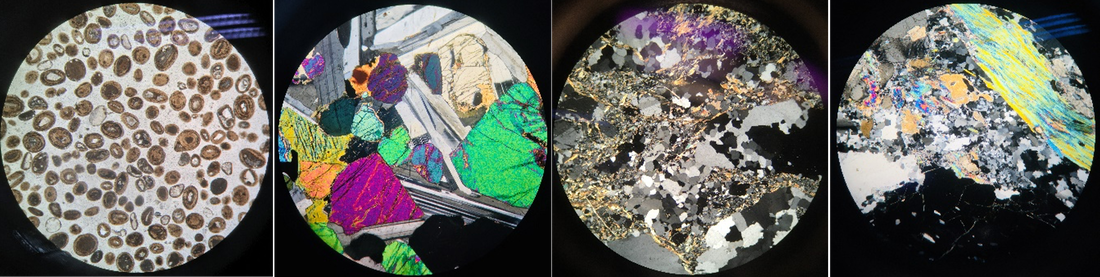
Quite a bit of your time throughout your degree will be spent analysing thin sections in the labs. Some samples are quite pretty!
|
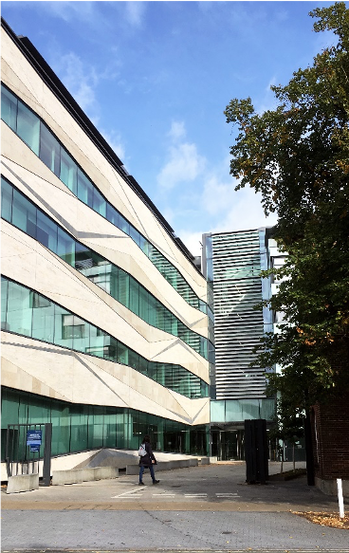
A view of the Earth Sciences Department building from South Parks Road, in North Oxford.
|
So, Earth Sciences. Should you choose it? Hopefully, I have given enough insight into what Earth Sciences involves that anyone interested in using a wide range of scientific and mathematical skills in an Earth context could say yes to my question. Of course, if these reasons were not enough to convince you, maybe the ‘Rocktails’ socials and field trips will!
What is the Earth Sciences course like?
|

Jon Hunt studied as an undergraduate at Worcester College
|
In first year, the bedrock is laid and levelled with all students facing A level science and maths reincarnated (Oxford-style). If you haven’t studied geology before, never fear – you are most certainly not alone. In second year, you’ll cover all things igneous, metamorphic and sedimentary, leading on to third year options in varying topics across the Earth Sciences.
My Experience
The combination of the sciences and nature, along with the possibility of travelling led me comfortably into the subject of Earth Sciences. In all honesty, my passion is not for rocks. This could make studying geology difficult but, apart from the incessant pun-based jokes, this hasn’t been my experience. I’ve really enjoyed the breadth of the subject and have appreciated the comfort of physical oceanography when caged in by mineral structure, or the physics of earthquakes when buried in sedimentology. The tutorial system works excellently to provide the connections I need between subjects, learning from the best in their field.
What Makes Oxford Different from Other Universities?
The Earth Sciences Department is a remarkably friendly haven in the sometimes harsh Oxford environment. Frequent field trips enable good friendships to form within year groups and the ever-active OUGS, with its Rocktails and Dino-onesie, provides a second college for those who join (everyone). Compared to other geological courses out there this one stays broader for longer, giving you a wider scientific and mathematical base to work from - if you’re not a maths nerd be prepared for compulsory calculus catch up in first year.
My Experience
The combination of the sciences and nature, along with the possibility of travelling led me comfortably into the subject of Earth Sciences. In all honesty, my passion is not for rocks. This could make studying geology difficult but, apart from the incessant pun-based jokes, this hasn’t been my experience. I’ve really enjoyed the breadth of the subject and have appreciated the comfort of physical oceanography when caged in by mineral structure, or the physics of earthquakes when buried in sedimentology. The tutorial system works excellently to provide the connections I need between subjects, learning from the best in their field.
What Makes Oxford Different from Other Universities?
The Earth Sciences Department is a remarkably friendly haven in the sometimes harsh Oxford environment. Frequent field trips enable good friendships to form within year groups and the ever-active OUGS, with its Rocktails and Dino-onesie, provides a second college for those who join (everyone). Compared to other geological courses out there this one stays broader for longer, giving you a wider scientific and mathematical base to work from - if you’re not a maths nerd be prepared for compulsory calculus catch up in first year.
The Fieldtrips
If field trips are the Earth Scientists’ precious gems, then the independent mapping project must be the crown jewel: six weeks, in a location entirely of your choice, exploring the local rocks (and cuisine) with friends. Although if you get lured to Scotland for the geology, prepare for midges, rain and a great deal of whisky (a necessary amenity).
For more information about the field trips click here.
If field trips are the Earth Scientists’ precious gems, then the independent mapping project must be the crown jewel: six weeks, in a location entirely of your choice, exploring the local rocks (and cuisine) with friends. Although if you get lured to Scotland for the geology, prepare for midges, rain and a great deal of whisky (a necessary amenity).
For more information about the field trips click here.
|
Copyright © 2020 Oxford University Geological Society
|
